Monday, January 28, 2008

SOA Approach to Integration [ SOA Books ]

This book for architects and senior developers responsible for setting up Service-Oriented Architecture (SOA) for intra-enterprise application integration (EAI) and inter-enterprise (B2B) integration focuses on process-centric SOA to integrate existing (legacy) applications and modern solutions, using new technologies: web services, XML, Enterprise Services Busses (ESBs), and Business Process Execution Language (BPEL). Application integration within and between businesses to make up-to-date information accessible almost anywhere is a difficult task that is growing in importance. This book shows how to best integrate applications developed in different architectures and programming languages on different platforms with modern e-business solutions, develop web services, and process and manage XML documents from the JEE and .NET platforms. It demonstrates how to use ESBs for service integration and BPEL executable business processes for service composition into business processes.

Amazon Reviews

This is a mediocre book that provides basic information but little of the insight that creates knowledge. As the title implies, it doesn't teach SOA in general, just how to approach application integration using SOA. Even in that, its treatment of the topic is reasonably accurate but superficial.

The book's six chapters are a reasonably logical overview of basic SOA and integration topics that finally culminates in the discussion promised by the book title.

The book demonstrates how SOA has risen in just a few years to a practical means of bolting together disparate online systems. Where these might have been coded and run with different languages and operating systems and web servers. Specifically, the book is concerned with the main choices out there these days. Java Enterprise Edition and Microsoft .NET. (Yes, Microsoft appears to be deprecating the ".NET" in some of its recent marketing, but for techies, that's still how we all refer to it.) Oh, it turns out there is a 3rd alternative, as the book is careful to point out. CORBA.

Buy this book from amazon store

Saturday, January 26, 2008

Naryanamurthy receives highest civilian honour of France


Infosys mentor N R Naryanamurthy was on Saturday conferred with the Officer of the Legion of Honour, the highest civilian distinction of the Government of France.

The French honour for Narayanamurthy comes on a day when he was chosen for Padma Vibhushan, the second highest civilian award of the country.

French Minister of Higher Education and Research Valerie Pecresse bestowed the honour to the "most admired business leader" of India at a glittering function here this evening.

Created in 1802 by Napoleon Bonaparte, the Legion of Honour is the highest civilian distinction that can be conferred in France regardless of the social status or the nationality of the recipients.

Pecresse acknowledged the humble beginnings of Infosys, which was co-founded by Narayanamurthy in 1981 along with six friends and 215 dollars in the pocket.

"Infosys, which employs over 82,000 staff, is a shining example of development in India," she said.

Accepting the distinction, Narayanamurthy said he was extremely greateful to the government of France for honouring him and try and work hard to deserve the confidence you have in me.

Narayanamurthy, who pursued higher studies in France, said it was a country he loves most after India.

"Today is a very important day .. I read in the newspapers this morning that I had been chosen for the Padma Vibhushan award. It was a pleasant surprise," he said.

Small companies in India think big

Much has been written about how the Nano from Tata Motors has changed forever the way India is perceived globally. Now after all the euphoria begins to subside, it’s time to ask some key questions. Is this the visible face of a wave of innovation that’s sweeping across India? And is India poised to become a hub for low-cost innovations for the world?

Ujwal Parghi would agree. As director of Shri Kamadhenu Electronics, the Anand-based company founded by seven young entrepreneurs with less than half a million rupees as seed capital, he’s been part of this wave. His firm has developed Akashganga, an automatic milk collection and accounting system that has made lives of dairy farmers in cooperatives, much easier.

What previously took over five minutes now gets done in just 30 seconds, saving dairy farmers from serpentine queues where they had to worry about their milk getting spoilt by the time it was measured. The machine incorporates a milk analyser that provides data on six parameters of milk simultaneously and helps monitor adulteration. read full story

Google Ad Business Susceptible To Recession

Google, Yahoo and other Internet companies fueled by online ads could well suffer in a recession, analysts say, but they expect the online ad market might hold up better than other media.

Soaring online ad growth has made Google GOOG a business juggernaut, while also adding to the coffers of other Internet companies.

In a recession, spending slows most everywhere, analysts say.

Investors haven't had to be reminded. Google shares have fallen nearly 20% this year and are down nearly 25% since hitting their all-time high in November.

Investors are nervous because Google, Yahoo YHOO and others get a lot of their ad dollars from the financial, real estate and retail sectors, Standard & Poor's (NYSE:MHP) analyst Scott Kessler says.

"Google has been one of the worst performers over the last week because people are concerned," he said. "They don't know how Google is going to fare amid this economic downturn."

Investors will get a better handle on things when Google and Yahoo release fourth-quarter results on Thursday and Tuesday, respectively. Paid search has been a boon for Google. Analysts expect the company to report fourth-quarter revenue of $3.44 billion, minus the traffic acquisition costs it pays partner sites that carry its ads. That would be up 54% from the year-earlier quarter.

Google gets 98% of its revenue from ads tied to its online search service. Paid search is the fastest-growing segment of the multibillion-dollar online ad market. Yahoo also gets most of its revenue from online ads. Yahoo and Microsoft's (NASDAQ:MSFT) MSFT MSN have been ramping up their paid search operations, looking for a bigger slice of that pie.

Paid search ads have become especially popular among smaller businesses because advertisers pay only when a consumer clicks on an ad. In a recession, ads from smaller businesses could become an Achilles' heal for Google, says Barry Parr, an analyst for Jupiter Research. full story

Google CEO bullish on mobile Web advertising


The arrival of a truly mobile Web, offering a new generation of location-based advertising, is set to unleash a "huge revolution", Google Inc Chief Executive Eric Schmidt said on Friday.

"It's the recreation of the Internet, it's the recreation of the PC (personal computer) story and it is before us -- and it is very likely it will happen in the next year," he told a panel at the World Economic Forum.

Current estimates for mobile advertising are cautious, with consultancy Forrester predicting revenues of under $1 billion by 2012.

But Schmidt said this figure was too low and failed to take into account the fact the mobile Web was reaching a tipping point.

Google aims to be a prime mover by bidding for coveted airwaves to launch an open U.S. wireless network, pitting it against established telecommunications players. The move will take the Silicon Valley-based company well beyond its core Web search and online advertising franchises.

Some analysts are worried at the high costs involved but Schmidt said he was confident location-based advertising -- which could, for example, direct hungry travelers to nearby restaurants -- would be "a very, very good business".

Content providers, already struggling in the modern world of music and film downloads, are less convinced that mobile Internet is a minefield.

"It is not going to be easy to hang on the price of content," said Howard Stringer, chief executive of Sony Corp.

Google mulls setting up global data centre in Taiwan

The world's largest search engine operator, Google, is considering setting up its global data centre in Taiwan, Taiwan's Central News Agency (CNA) said on Saturday.

Steve Chen, the economics minister of Taiwan, on Friday confirmed that Google was mulling launching a centre in Taiwan for data storage. The ministry has reserved a piece of land in the Changpin Industrial Park in Changhwa, western Taiwan.

Taiwan will offer incentives, such as a discount on the land tax, to Google and ensure a stable electricity supply, Chen said.

According to CNA, Google has considered 18 locations outside the US, including Taiwan, Japan and South Korea, to build its data storage centre, but is leaning towards Taiwan.

Wednesday, January 16, 2008

Oracle to buy BEA for $8.5 billion

Oracle, the Redwood City software giant, said today it is buying BEA Systems of San Jose for $8.5 billion, ending a courtship that began last fall with BEA's rejection of a lower offer for the middleware maker.

The announcement before the stock market opened sent BEA's shares sharply up when trading started, up 19 percent to $18.53 a share. Oracle was slightly down at $21.29 a share.

The agreement calls for Oracle to acquire all outstanding shares of BEA for $19.375 - a hefty premium over the $17 a share Oracle originally offered, but less than the $21 a share that BEA's board of directors was demanding.

For that price, Oracle gets the company plus its $1.3 billion cash on hand. Oracle executives expect it to also boost the company's earnings; Safra Catz, Oracle president and chief financial officer, said in a statement released today that Oracle expects the deal to add to Oracle's earnings "by at least one to two cents."


But analysts had noted that Oracle could use much of BEA's middleware technology, which is compatible with Oracle's Fusion software. Oracle CEO Larry Ellison said the addition of BEA products and technology "will significantly enhance and extend" Oracle's own suite of middleware products.

Alfred Chuang, BEA's chairman and CEO, said the transaction "is in the best interest of our shareholders. I am confident our innovative products, talented employees and worldwide customer base will be key
contributors to the success of the combined company over the long term. We look forward to working with Oracle toward a successful completion of the transaction."

BEA came under pressure to sell after Wall Street investor Carl Icahn began acquiring shares in the San Jose company last year. He eventually became the largest shareholder, Originally, Icahn had agreed with BEA's rejection of Oracle's $17 a share offer, but later he began agitating for a sale at that price. But Icahn fell silent after signing a non-disclosure agreement and getting a close look at BEA's technology and financials.

"Both companies will do very well," said Trip Chowdry, managing director of Global Equities Research. He said BEA's social computing products will give Oracle an entry into that growing sector. Customers of BEA should be pleased, he said, "because they were wanting BEA to be bought by Oracle as 70 percent of Oracle database customers are also BEA's customers."

The deal is expected to close by the middle of this year, subject to BEA stockholder and regulator approvals.

In morning trading, shares of BEA jumped 19 percent, or $2.96, to $18.54. Oracle investors were less excited, pushing shares of the company up 13 cents, or 0.61 percent, to $21.44.

Sun to buy out MySql for $1 billion

Sun Microsystems will plunk down $1 billion to buy MySQL, the maker of a popular open-source database.
Sun said Wednesday that it will pay about $800 million in cash for MySQL's privately held stock and will assume about $200 million worth of options. MySQL CEO Marten Mickos will join Sun's senior executive team after the transaction closes.

The acquisition is a bold move for Sun, which has embraced open-source software and development practices in an effort to garner more revenue from its software business. Until now, it has sold support services for a competing open-source database, PostgreSQL.

MySQL is one of the most successful open-source companies founded in the past five years. It's part of the popular combination of open-source development products referred to as LAMP , for Linux Apache Web server, MySQL and the PHP development language, which is broadly used on the Internet and within companies.

Mickos had previously said that the company intends to go public rather than be acquired. Its business model is to give away the source code and its database for free and to charge customers an ongoing subscription fee for support and services.

In his blog, Sun CEO Jonathan Schwartz said that Sun will begin offering support services to customers of MySQL before the deal closes later this year.


In a conference call, he called the deal the most important acquisition in the history of Sun.

Schwartz also outlined a number of areas of technical integration designed to optimize MySQL's flagship database--as well as MySQL's Falcon storage engine--on Sun's Solaris operating systems and servers.

He said that Sun can provide the sort of support services that large corporations demand.

MySQL is a "part of every Web company's infrastructure, to be sure. And though many of the more traditional companies use MySQL (from auto companies to financial institutions to banks and retailers), many have been waiting for a Fortune 500 vendor willing to step up, to provide mission critical global support," Schwartz said.

The size of the acquisition, at $1 billion, reflects the indelible mark that the open-source business model--in which companies give away source code and charge for services or high-end products--has left on the software business.

JBoss, another successful open-source software company, was acquired for more than $400 million by Red Hat in 2006. And last year, Citrix paid $500 million for XenSource, a virtualization software provider.


"This is a great move for Sun, and answers the question of 'SunDB' that Scott McNealy posed several years ago," said The 451 Group analyst Raven Zachary.

However, the acquisition also comes with some potential difficulties. "This raises a whole bunch of issues concerning Sun's close ties to Oracle, as well as their investment in PostgreSQL," Zachary said.

He believes other potential suitors include Red Hat, Sybase, Hewlett-Packard, and Oracle.

MySQL, which is based in Cupertino, Calif., and Uppsala, Sweden, has about 400 employees. Investors include Benchmark Capital, Index Ventures, IVP, Intel, SAP, Red Hat.

The deal is expected to close near the tail of Sun's fiscal third quarter, which ends in late March, or early in its fourth quarter.

Tuesday, January 15, 2008

San Francisco Geared Up For Macworld

http://www.macrumors.com/mwsf/


Macworld 2008

Stand in line here for Keynote


Sunday, January 13, 2008

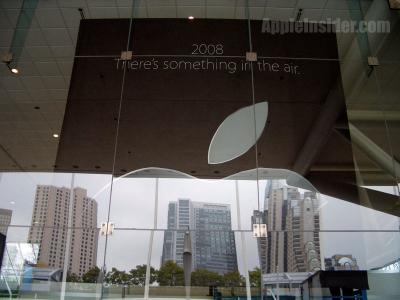
2008 There’s something in the air


Appleologists, train your furrowed brows on the first banners up at Macworld 2008. As the work crews set up this morning, Moscone South has the first hint of what is to come.

Read More

Thursday, January 10, 2008

Best Buy announced plans to sell more Macs than ever this year


Katie Marshall reports for AppleInsider that Best Buy gave some insight into its plans for the immediate future at the CES 2008 and it’s good news for potential buyers of our favorite computing platform. Best Buy executives commented that the company plans to double the number of stores carrying Macs, a number that is currently pegged in the vicinity of 230-270 retail locations, in the next couple of months.

This means that by the end of February 2008, roughly 500 of the 900 total Best Buy stores will be selling the best computers money can buy (see what I did there?). We’re, of course, glad to hear this latest development: the more Macs you see on store shelves, the better an indication it is of their growing popularity. And that can only be good, right?

Macworld Expo 2008 Keynote Live Coverage: Web, SMS, iPhone

MacWorld at San Francisco is just one week away. There is lot of speculation about the upcoming new products. One amoung in the list is ultra-thin laptop.


mac rumours writes in details here

SCBCD books - Manning Publications (Paul Sanghera)


Manning Publications (Paul Sanghera)

This is a good book to learn the concepts of EJB but for the exam you need the HFEJB book. The details of Context objects (which method of Context object you can use in which method call of the Bean class) are more descriptive in HFEJB If you are planning to sit for the exam this book should be accompanied by HFEJB

Order this book from amazon

SCBCD Books - Head First EJB (Kathy Sierra, Bert Bates)


Head First EJB (Kathy Sierra, Bert Bates)

What do Ford Financial, IBM, and Victoria's Secret have in common? Enterprise JavaBeans (EJB). As the industry standard for platform-independent reusable business components, EJB has just become Sun Microsystem's latest developer certification. Whether you want to be certifiable or just want to learn the technology inside and out, Head First EJB will get you there in the least painful way. And with the greatest understanding. You'll learn not just what the technology *is*, but more importantly, *why* it is, and what it is and isn't good for. You'll learn tricks and tips for EJB development, along with tricks and tips for passing this latest, very challenging Sun Certified Business Component Developer (SCBCD) exam.

Buy this book from Amazon store

SCWCD 1.4 Book - Professional SCWCD Certification (Wrox Publications)


Professional SCWCD Certification (Wrox Publications)


This book is a complete, definitive study guide for gaining a certification pass in the Sun Certified Web Component Developer (SCWCD) exam (310-080). Each chapter is structured around one section of the exam objectives and follows it closely. This helps you to focus on learning what is necessary for the exam without surrounding clutter. By the end of each chapter you will have the knowledge required to answer any question on the subject that could appear in the exam. A revision sheet and exam-standard questions follow each chapter to further reinforce the topics in that chapter.

What's more, the book has been design to be useful beyond the study period. All the objectives are explained using real-world examples so that your can come back to the book for reference. In addition to this, the book contains a large case study that will integrate all the topics and objective you have learned through the rest of the book. Java web applications are more than a disparate collection of topics and as such the case study pulls together all the topics in the book to give some context to the whole technology.

The book provides all that you will need to become a fully certified, professional Java web developer.

Buy from Amazon book store


SCWCD 1.4 Book - Hanumant Deshmukh (Manning Publications)


SCWCD 1.4 Book - Hanumant Deshmukh


Aimed at helping Java developers, Servlet/JSP developers, and J2EE developers pass the Sun Certified Web Component Developer Exam (SCWCD 310-081), this study guide covers all aspects of the Servlet and JSP technology that Sun has determined necessary. This new edition adds aspects of servlet/JSP development, such as the Expression language, and updated materials of servlets with a particular focus on using filters to make request processing more efficient. Covering the reliance on the JSP Standard Template Library (JSTL) and its core, this guide allows JSP developers will be able to simplify their development process and remove Java-based scriptlets and expressions from their code. All applications in this book are designed to run on Apache's latest development server, Tomcat 5.0, and instructions on how to install this new edition and execute servlets and JSPs are included.

Buy from Amazon book store

SCWCD 1.4 Book - Head First Servlets and JSP (Kathy Sierra,Bert Bates,Bryan Basham)


Head First Servlets and JSP


No problem. Head First Servlets and JSP's brain-friendly approach drives the knowledge straight into your head (without sharp instruments). You'll interact with servlets and JSPs in ways that help you learn quickly and deeply. It may not be The Da Vinci Code, but quickly see why so many reviewers call it "a page turner". Most importantly, this book will help you use what you learn. It won't get you through the exam only to have you forget everything the next day.

Learn to write servlets and JSPs, what makes the Container tick (and what ticks it off), how to use the new JSP Expression Language (EL), what you should NOT write in a JSP, how to write deployment descriptors, secure applications, and even use some server-side design patterns. Can't talk about Struts at a cocktail party? That'll change. You won't just pass the exam, you will truly understand this stuff, and you'll be able to put it to work right away.

This new exam is tough--much tougher than the previous version of the SCWCD. The authors of Head First Servlets and JSP know: they created it. (Not that it EVER occurred to them that if they made the exam really hard you'd have to buy a study guide to pass it.) The least they could do is give you a stimulating, fun way to pass the thing. If you're one of the thousands who used Head First EJB to pass the SCWCD exam, you know what to expect!

Buy from Amazon book store

Monday, December 31, 2007

SCJP 1.5 Books

SCJP 1.5 Book - Kathy Sierra and Bert Bates

Get the book that shows you not only what to study, but how to study. The only classroom-based integrated study system for professional certification gives you complete coverage of all objectives for the Sun Certified Programmer for Java 5 exam, hundreds of practice exam questions, and hands-on exercises. The CD-ROM features full practice exam software plus an adaptive test engine. buy now

SCJP 1.5 Book - Khalid A. Mughal and Rolf W. Rasmussen

A programmers Guide to Java™ Certification, Second Edition, contains detailed coverage of all exam topics and objectives, helpful code examples, exercises, review questions, and several full practice exams. In addition, as a comprehensive primer to the Java programming language, this book is an invaluable reference tool for the reader.

This new edition has been thoroughly updated to focus on the latest version of the exam (CX-310-035). In particular, it contains more in-depth explanations of the syntax and usage of core language features that are now emphasized on the exam. The accompanying CD contains a version of the SCPJ2 1.4 Exam Simulator developed by Whizlabs software, which includes several mock exams and simulates the exam-taking experience. The CD also contains the complete source code for all the examples, and solutions to the programming exercises. buy now

Sunday, December 30, 2007

SCJP 1.6 - What is new?

There is few minor changes from the previous version 5.0. Objectives are very similar to SCJP 5.0 exam except that few minor updates. In the following section bolded topics are updated in SCJP 6.0.

SCJP 1.6 - NavigableSet
SCJP 1.6 - NavigableMap

read full article

SCJP 1.6 - Buy 350+ Mock Questions

HI,

We have prepared 350+ mock questions for SCJP 1.6 exam. The questions from this
kit is spread over all the objectives. In additional we have prepared questions for the SCJP 1.6 topics NavigableSet, NavigableMap,Concole,GarbageCollection and Finalize method. These are the topics newly added to the SCJP 1.6 exam. You can buy this questions for JUST Rs.250 from the following link:

SCJP 1.6 Certification Kit

Monday, December 17, 2007

Buy JavaBeat MockExams eBook for SCJP 5.0

We have created 300+ Mock questions for SCJP 1.5. The questions in the eBook is more focused on the SCJP 1.5 specific topics. For example, we have added 53 questions for generics topic. It will help user to get good knowledge on the subject. You can buy the kit for JUST Rs.200 from the following link:
SCJP 1.5 Mock Exams Questions

Apple's Steve Job's Successor


The Times has reignited the debate around the eventual successor to Steve Jobs, suggesting that it might be the company's UK-born design chief, Jonathan Ive.

In an article drawing purely on speculation the newspaper suggests that Ive is the best candidate to succeed Jobs, Apple's co-founder and chief executive. In Ive's favour, a design portfolio that includes four generations of the iMac, the iPod and the iPhone. And he is not a dull American businessman, unlike current Apple number two, Tom Cook. read more

Apple's Steve Jobs in Time Magazine

Feb. 15, 1982
Aug. 18, 1997
Oct. 18, 1999
Jan. 14, 2002
Oct. 24, 2005
May. 14, 2007

Tuesday, November 27, 2007

Event Driven Programming with JSF

Event Driven Programming with JSF

This article discusses theories and concepts related to JSF Event Model. It details the supporting high level classes and interfaces that are involved in JSF Event Handling Mechanism. The logical categorization of JSF Events is also explained along with code snippets. Then, the tags available in the core JSF Framework are also discussed.

Accessing Web Services from JSF applications

Accessing Web Services from JSF applications

In this technical article, let us see how it is possible to access Web Services from JSF Applications. JSF Application resides in the Web Tier of a typical Enterprise Application, whereas Web Services are External Services that reside in the Application Tier. We make use of Java EE 5 for developing the Sample Application in the final section of this article. It is assumed that readers have sufficient knowledge of JSF and Web Services before continuing this article.

Monday, September 24, 2007

jUDDI and Configuration in jBoss and MySQL database

UDDI is one of the core Web Service standard. It provides access to Web Service Description Language which provides binding information and message formats required to interact with the web services listed in its directory. Enterprises that seek to optimize software or service reuse subscribe to some form of service-oriented architecture (SOA), server programs or database software licensed by some of the professed founders of the UDDI.org and OASIS.

jUDDI and Configuration in jBoss and MySQL database [Discuss Here]

Sunday, September 09, 2007

Introduction to Spring IDE 2.0

This article will introduce you with Spring IDE 2.0. Spring IDE 2.0 is a plugin for developing Spring Applications with ease in Eclipse IDE. This article will walk you through the various steps involved in installing Spring IDE 2.0 in Eclipse. This article also describes common tasks done in Spring Framework way using Spring IDE 2.0 plugin.

Introduction to Spring IDE 2.0 [Discuss Here]

Tuesday, August 14, 2007

Universal, Description, Discovery and Integration (UDDI)

Welcome to the future of Internet-based application development and deployment. This article will give us an idea about Universal, Description, Discovery and Integration (UDDI). What is it ? Why it is an important in the future of Web services standards ? This article explains that UDDI is focused on sharing business information, making it easier for you to publish your preferred means of conducting business, find trading partners and have them find you, and interoperate with these trading partners over the Internet. This artical assumes that you already have knowledge about little bit of HTTP, SOAP, and Web Services.

Universal, Description, Discovery and Integration (UDDI) [Discuss Here]

Generics in Java 5.0

The feature of Generics in Java allows Applications to create classes and objects that can operate on any defined types. Programmers can now make use of the Generics feature for a much better code. There is no need for un-necessary casting when dealing with Objects in a Collection. This article provides a detailed overview of Generics and its usage in different context with samples. To start with, it illustrates the need for Generics and the difficulties faced by the Developers before its origin. It will explain in detail on how to write Generic Classes, Generic Methods and so on. Then the various aspects of Bound Constraints and Wild-cards will be discussed.

Generics in Java 5.0 [Discuss Here]

New Features in Java 5.0

Java 5.0 comes with a bunch of useful features. In this article, we are going to have an overview of the features like Enhanced for-loop, Variable Arguments, Static Imports and Enumerations. The sections in this article are,

New Features in Java 5.0 [Discuss Here]

AutoBoxing in Java 5.0

In the latest version of J2SE 5.0 released by Sun, Autoboxing is one of the new feature. Before J2SE 5.0, working with primitive types required the repetitive work of converting the primitive types into wrapper classes and vice - versa. Sometimes the purpose of conversion is just for some API call, after which the results have to be converted into original form which is very frustrating .Auto-boxing and Auto-Unboxing enables the primitive types to be converted into respective wrapper objects and the other way around.This article gives some insight about the importance of this new feature and how it can be used in the real-world programming.

AutoBoxing in Java 5.0 [Discuss Here]

Introduction to Java 5.0 Annotations

Annotations in Java is all about adding meta-data facility to the Java Elements. Like Classes, Interfaces or Enums, Annotations define a type in Java and they can be applied to several Java Elements. Tools which will read and interpret the Annotations will implement a lot of functionalities from the meta-information obtained. For example, they can ensure the consistency between classes, can check the validity of the paramters passed by the clients at run-time and can generate lot of base code for a project. This article provides you a complete guide detailing the various aspects of Annotations. The topics covered in this article are as follows,

Introduction to Java 5.0 Annotations [Discuss Here]

Introduction to Google Guice

Google Guice is a Dependency Injection Framework that can be used by Applications where Relation-ship/Dependency between Business Objects have to be maintained manually in the Application code. Since Guice support Java 5.0, it takes the benefit of Generics and Annotations thereby making the code type-safe.

Introduction to Google Guice [Discuss Here]

Google Web Toolkit(GWT) – A Kick Start

Normally an Ajax application is built by creating XHTML pages and JavaScript code with a suitable integrated development environment (IDE). A number of different libraries and frameworks exist by which programmers can use pre-designed JavaScript classes to implement otherwise time-consuming dynamic behaviors,

Google Web Toolkit(GWT) – A Kick Start [Discuss Here]

Introduction to J2ME

J2ME (Java 2 Micro Edition) is an advanced technology in Java, developed with the help of Java Community Process Program. J2ME is a reduced version of the Java API and Java Virtual Machine that is designed to operate within the limited resources available in the embedded computers and microcomputers.
Introduction to J2ME

Sunday, July 29, 2007

Dell to Introduce More Linux OS Desktops and Notebooks


PC maker Dell has announced its collaboration with Canonical Inc. Both companies together will soon offer more desktops and notebooks incorporating the Linux operating system instead of Windows.

Mark Shuttleworth, founder of the Canonical Inc said, “What’s been announced to date is not the full extent of what we will see over the next couple of weeks and months. There are additional offerings in the pipeline.”

Gerry Carr, Marketing Manager at Canonical said, “This is the next great battle and this is where Linux has never really been before - Linux as a consumer product.”

However Dell has refused to make any comment on the collaboration but has said that the company is happy with the response towards its Linux PCs launched earlier.

Seems very soon Linux operating system is going to give a tough fight to Windows of Microsoft.

Friday, July 27, 2007

Programming Web Services using Apache Axis

The article titled Programming Web Services using Apache Axis shows how Axis Framework has simplified the creation of Web Services. It will start with the definition of Web Services and its related terminologies like SOAP and WSDL. Following that the ease with which Web Services are published are explained. The later section explores about the various tools available in the Axis distribution like the Tcp Monitor, Soap Monitor, Mapping between Java and WSDL. Finally the article ends up by giving a Sample Web Service Application deployed in Axis. read full article

Introduction to Eclipse Plugin Architecture

This article will guide you in creating Eclipse Plugins using the Eclipse Plugin Development Environment (PDE). Because the Plugin Development Architecture is vast, this article will only provide brief information about the various components that fits into the PDE. It starts off in creating a Simple Plugin and they will try to explain the various pieces involved in the Plugin Development. More specifically this article will show how to create a View based Plugin, an Action based Plugin and a Preference-based Plugin. read full article

Saturday, July 21, 2007

Introduction to JavaFX Canvas

The JavaFX Canvas supports a 2D vector graphics scene-graph model with a declarative API similar to Scalable Vector Graphics (SVG). Using this API we can declaratively create visual effects that combine Swing components together with 2D graphics. Any object in the canvas including Swing components can be translated, rotated, scaled, skewed blurred, reflected, shadowed etc... read full article

Introduction to Struts Actions

Action classes will be defined to handle requests. Actions exists between the Model and View of an application. This article will cover all of the standard actions and the helper methods of the Action class. read full article

Wednesday, July 18, 2007

Bharti awards $2 bn contract to Ericsson


Bharti Airtel, the country's largest mobile operator, today awarded a two billion dollar (Rs 8,000 crore) contract to Swedish equipment supplier Ericsson for expanding its telecom network.

The two-year deal is one of the biggest contracts for Ericsson. Under the contract, Ericsson will design, plan, deploy and manage Bharti's GSM network across 15 circles and its pre-paid platform across 23 circles in the country.

In addition, Ericsson will also deliver pan-India integrated device management solutions, enabling usage of advanced data services by all mobile customers of Bharti across retail and enterprise segments.

"This contract is an important part of realising Bharti's vision of a converged network and of expanding coverage in rural India to launch innovative voice and data services for Indian consumers," Ericsson India Managing Director Mats Granryd told reporters here.

"We are honoured that Bharti has chosen to partner with us in this grand venture that underpins our strategy of providing communication for all through sustainable and innovative solution," he added.

Will The FTC Block Google’s Acquisition Of DoubleClick?


Scott Cleland, an analyst at the Washington, D.C. based telecom research group Prescursor has published a 35 page paper “Googleopoly: the Google-DoubleClick Anti-Competitive Case”. The paper argues that the US Federal Trade Commission will block Google’s $3.5 billion acquisition of DoubleClick on the basis that it will allow “Google to dominate online advertising and dramatically increase the opportunity for market collusion and price manipulation in the market for consumer click data, ad-performance tools, ad-brokering and ad-exchanges.”

Those interested can read the full report here. The stand out portion of Cleland’s report is how he describes Google dominance of the online advertising market post acquisition:

To equal Google-DoubleClick’s level of market concentration in the intermediary online advertising market, one single financial services company would have to own:

* The top 15 Wall Street banks/asset managers;
* ~60% of the hedge fund and private equity industries;
* The New York and London Stock Exchanges;
* The two leading providers of financial analytical tools: Bloomberg and Factset;
* Two of the three national providers of credit profiles: Experian and Equifax; and
* ~60% of the Federal Reserve’s and U.S. Census Bureau’s raw market and consumer data. More>>

Tuesday, July 17, 2007

What is Mobile 2.0?


It seems the Web 2.0 concept is building up a lot of steam. So I think this is a good time to talk about another transition I’ve been thinking about recently: Mobile 2.0.

Now I’ll be the first to admit that what the blogosphere doesn’t need right now is Yet Another Pointless Meme (YAPM?). But the phrase Mobile 2.0 really seems to capture what this trend is about - the convergence of mobile devices and web services creating an entirely new dynamic. Once the web is truly a platform (although some would argue that it will never reach this stage), our mobiles won’t need to run applications or store massive amounts of data. The vast majority of these applications will exist on the network, with our data spread across the wide array of loosely coupled web services we use everyday. I expect you already upload your photos to Flickr, keep track of your links on del.icio.us or store and share your videos with YouTube, but I see this trend continuing to a point at which most of our data is in the cloud, and only a tiny fraction of it is stored locally. To some followers of Web 2.0, this evolution seems blatantly obvious, but I think we’ve yet to explore the true ramifications of the mobile web.

One likely scenario is the emergence of location-based advertising. It seems that Google, with its movement towards local search, its mapping expertise and its successful contextual ad system, is well-positioned to take advantage of the new dynamic. This MobHappy post gives us a flavour of what’s to come:

Your phone has…become your primary means of accessing the internet, again via Google Net, obviously. Your phone is a thin client, with most storage and processing done on the web. Most people don’t have even a PC anymore. If they want to do work that involves a keyboard and a bigger screen, they just pop their phone into the nearest docking station and away they go. With the added advantage that the phone has ensured that the screen layout, favourite apps, bookmarks and files are all available exactly as you’d want them…

So suddenly, true location based marketing becomes a reality, no longer a question like “when the tech is available” or “providing you’re in line of sight” or “if it’s accurate enough”.

The idea of the “docking station”, with a bigger screen and a full-sized keyboard, is a popular image of our mobile future. When we no longer need to be mobile (at work and at home, for example), we plug our phone into the dock and enjoy all the benefits of a fully-fledged PC. I’ve posted about this concept here and here. And Philip Greenspun has looked into how the docking station might work in practice:

A mobile phone has substantially all of the computing capabilities desired by a large fraction of the public. Why then would someone want to go to the trouble of installing and maintaining a personal computer (PC)? The PC has a larger keyboard and screen, a larger storage capacity, can play more sophisticated games, and has a faster communications capability.

This is a plan for building an appliance into which a mobile phone plugs and that extends the phone’s capabilities without requiring the consumer to become a system administrator or be aware that he or she owns more than a phone. In the rest of this document we will call the new device “The Appliance”…

It’s also interesting to imagine how content will evolve to fit the mobile platform. We’ve already seen content broken down into smaller chunks to cope with our busy lifestyles and short attention spans, but once we’re faced with digesting content on the go (perhaps on a tiny screen), that content will no doubt have to be even more concise. In essence, we’ll need better filtering to create shorter, more relevant snippets of content. But how will we create this content? Moblogs and cameraphone snaps seem to be gaining adoption, but mobile video is on the way, too. And if services like Scoopt and SpyMedia are anything to go by, then the content creators of Mobile 2.0 can expect to get paid for their efforts.

There is much more to be said about Mobile 2.0 - its impact on social networking, web design and payment systems will also be interesting areas to explore. But I’ll leave all that for another post. And before you start pulling these theories to pieces, let’s remember that Mobile 2.0 is just a hypothesis. I also accept that Mobile 2.0 isn’t even the correct term here - perhaps I’m really talking about Web 3.0, or simply the mobile internet. But let’s keep an eye on how these trends develop over the next few years - you never know, we might be on to something!

Google to Launch a Search Engine for Ringtones


The Wall Street Journal reports that Google works on a search engine for mobile media content that will include ringtones and games.

"With the new system, users would search for a piece of content -- such as ringtones -- and would get back a list of companies that provide it, with links letting them easily purchase the material. (...) The company has been working for months with content providers -- including large entertainment companies and smaller mobile media aggregators -- to index their material and make it available via mobile search. (...) The Internet company has considered including a social-networking component that would let users of Google's Gmail email service exchange content, one person familiar with the initiative said. Google declined to comment."

Google has launched mobile versions for most of its services, including search, Gmail, Google Maps, YouTube and it's now testing AdSense for mobile content. But a search engine for ringtones and games could jeopardize Google's partnerships with many carriers that want to keep the customers inside their "walled gardens". There aren't many good services in this space (Mogmo comes to my mind), so Google's search engine will actually fill a void. Until some carriers decide to block it.

Sienna Miller, Amitabh join anti global warming drive


British actor Sienna Miller teamed up with Bollywood star Amitabh Bachchan on Tuesday to urge Indians to do more to slow global warming.

The actor met Bachchan in Mumbai on Tuesday at the start of a weeklong trip to India as an ambassador for Global Cool, an organization that spreads awareness about global warming.

Miller said people could help by turning their air conditioners down by even one degree or by turning off phone chargers and other electronic equipment when it's not being used.

``If each one of us does our bit, we will be helping to keep global warming from harming our countries,'' she said.

Bachchan announced that the Indian International Film Academy would partner with Global Cool to increase knowledge about greenhouse gas emissions.

``Carbon emissions will be huge from countries like India and China with growing populations and economy,'' said Bachchan. ``It will be wise to start doing whatever we can to protect our planet.''

Miller, 25, acted in the films ``Casanova,'' ``Layer Cake'' and ``Alfie.''

Learn about Global Warming to Rescue the World


Global warming isn’t opinion. It’s a scientific reality. And the science tells us that human activity has made enormous impacts to our planet that affect our well-being and even our survival as a species.

The world’s leading science journals report that glaciers are melting ten times faster than previously thought, that atmospheric greenhouse gases have reached levels not seen for millions of years, and that species are vanishing as a result of climate change. They also report of extreme weather events, long-term droughts, and rising sea levels.

Fortunately, the science also tells us how we can begin to make significant repairs to try and reverse those impacts, but only through immediate action. That’s why we urge you to join us. The Stop Global Warming Virtual March is virtual but its purpose is real. By spreading the word and sharing this with others, our collective power will force governments, corporations, and politicians everywhere to pay attention.

What is Global Warming?

The Earth as an ecosystem is changing, attributable in great part to the effects of globalization and man. More carbon dioxide is now in the atmosphere than has been in the past 650,000 years. This carbon stays in the atmosphere, acts like a warm blanket, and holds in the heat — hence the name ‘global warming.’

The reason we exist on this planet is because the earth naturally traps just enough heat in the atmosphere to keep the temperature within a very narrow range - this creates the conditions that give us breathable air, clean water, and the weather we depend on to survive. Human beings have begun to tip that balance. We've overloaded the atmosphere with heat-trapping gasses from our cars and factories and power plants. If we don't start fixing the problem now, we’re in for devastating changes to our environment. We will experience extreme temperatures, rises in sea levels, and storms of unimaginable destructive fury. Recently, alarming events that are consistent with scientific predictions about the effects of climate change have become more and more commonplace.
Read from Wiki

Visit http://www.stopglobalwarming.org/

`Robo`- Shankar's next film


Shankar is going to get a red carpet reception, when he comes back to Chennai tomorrow (Tuesday July 3), after a month long sojourn abroad. Three weeks after its release, his Sivaji continues to rock, and superstar Rajnikant has given him full credit for it, by saying- "Shankar is the creator of the film and he has worked hard for it".

Now, what next is the question people in the industry are asking? According to sources close to him, Shankar will be totally concentrating on the films being made under his banner 'S'pictures for the next three months. He will be giving some creative inputs to his in-house directors Balaji Sakthivel, and Simbudevan who are immersed in the making of their films for the company.

Meanwhile the grapevine is abuzz with rumours that Shankar is finally starting work on his ambitious pet project Robo, a futuristic science fiction thriller set in the year 3050 of Chennai. The entire shoot of the film can happen only on sets, and also involves a lot of CG work, to give the futuristic look to the film. And that means millions of dollars, and a producer willing to blow up money, and a bigger market to exploit the film.

Actually Shankar has a commitment with Telugu financier and producer Tirupati Prasad to make a film for him. But the latest we hear is that a major Bollywood production house has roped in Prasad as Executive producer, and together they are planning to make the Shankar film in Hindi for a global audience. The production house has also the "dates" of Hrithik Roshan, who is keen to do a film with Shankar.

Though Shankar had initially talked about doing the project with Kamal Hassan in Tamil, he realizes that for such a big project you need a Bollywood hero for the global audiences. Imagine Hrithik, Hindi cinema's best action hero ( Krissh,Dhoom-2), A.R Rahman the only Indian musician with an international following and Shankar. The combination will rock!

And the latest on Robo is that a Hollywood studio, who is already making a film in Hindi, has shown an interest in the project. They want to be co-opted as presenters of the film, are willing to partly fund the project, which will definitely cost upward of Rs 100 crore. Now the ball is in Shankar's court. He will have to take a call in the next few weeks.

Monday, July 16, 2007

How Apple Can Win The PC Battle


According to Apple Insider, just a year ago Apple's share of the computer market was close to 2%. Now MacWorld and CNet are reporting that - according to NDP research - Apple's Desktops have crossed 10% and the MacBooks now closing on 15% of the laptop market. This puts MacBooks in 4th place behind HP, Toshiba and Gateway. The figures are likely to increase in the 3rd quarter, which is traditionally strong for Apple, because of the back-to-school sales.

The above stats are backed up by my own experiences. When I walked into the BestBuy store recently, something was very different. It took me a second to realize that among the usual scenery, I was also looking at a big section featuring Macs. So Apple is back with a vengeance and has re-ignited the PC war. Despite dropping the word computer from its name, Apple still desperately wants to win the PC market.

But why? Surely Steve Job's spite and ego play a role, but more importantly, desktops and laptops still hold the lion's share of profitability in the computing industry. The computer is becoming, if it has not already become, the personal media center. Laptops are literally everywhere and it is likely to remain the same way for at least a decade. So Apple is fighting as hard as it can to fix its mistake of the past - letting Redmond win the personal computing market.More>>

J2EE Connector Architecture(JCA) - An Introduction

JCA, the J2EE Connector Architecture, is an initiative towards EAI, Enterprise Application Integration. It is a standardized architecture providing the J2EE Components to have plug and play access to heterogeneous EIS, Enterprise Information Systems. Examples of EIS are ERP (Enterprise Resource Planning), Transaction Processing Systems, Legacy Database Systems etc. read full article

Using JSF and AJAX with Ajax enabled JSF implementations - Ajax4Jsf

With the advent of internet, there has been constant paradigm change from time and again. There are many scripting web languages which came and showed their impact now and then. But the feature I am going to talk about will give a close look to internet as a close friend. In this article, read full article

Object Oriented Concepts in PHP 5.0

PHP, an acronym for PHP: Hypertext Preprocessor, is a scripting language that is used for creating dynamic and interactive web pages. PHP is widely used and can be freely downloaded from http://www.php.net/downloads.php read full article

SimpleXML in PHP 5.0

PHP, an acronym for PHP: Hypertext Preprocessor, is a general purpose scripting language that is used to create dynamic web pages. Recently, a newer version of PHP was released and it is popularly known as PHP 5. The top seven features with PHP 5 are: read full article

SQLite with PHP 5.0

PHP, an acronym for PHP: Hypertext Preprocessor, is a scripting language that is used for creating dynamic and interactive web pages. PHP is widely used and can be freely downloaded from http://www.php.net/downloads.php. read full article

Tech Jokes


4 Years Ago Today - Netscape Corporation Killed, Mozilla Foundation Born


4 years ago today, 15 July 2003, AOL Time Warner disbanded Netscape Communications Corporation - the company that sparked the Dot Com Internet boom in the mid-90's with its 1995 IPO. Also 4 years ago today, The Mozilla Foundation was established. mozillaZine reported at the time:

"It has been learned through public and private sources that AOL has cut or will cut the remaining team working on Mozilla in a mass firing and are dismantling what was left of Netscape (they've even pulled the logos off the buildings). Some will remain working on Mozilla during the transition, and will move to other jobs within AOL.

The news isn't all doom and gloom, folks. I've been informed that the number of volunteer Mozilla hackers started eclipsing the number of Netscape hackers last month, and that a number of folks have already been snatched up by other organizations. ".More>>

Sunday, July 15, 2007

Google, Yahoo may be eyeing Rediff


US-based Internet giants such as Google and Yahoo are eyeing Rediff.com India Ltd, which runs one of India's most popular consumer Internet portals, for a possible acquisition. Investment banking sources told Hindustan Times that the management of Nasdaq-listed Rediff was in talks with the global companies for a negotiated takeover deal.

Rediff, Google and Yahoo officials could not be immediately reached for their comments. Talk of the deal is emerging in the context of a general worldwide rebound in the Internet business, and India emerging as a hot story in the global economy with strong growth in both telephone penetration and the Internet in urban areas.

Leading US-based investment journal Barrons reported this month that Rediff is seeing speculation that it could be a takeover target. Rediff’s stock has witnessed a sharp jump in share price and volume on Nasdaq over the past week, when it also launched a Website to help consumers upload voice, video and photographic content for free.

The company's stock moved up to $25.41 per share on July 13 from $17.94 on July 5 and. The trading volume has increased to more than a million shares from an average of 50,000 share a day. In fact, on July 12, Rediff shares closed at $26.46 and more than 3.3 million shares traded hands. The company has a current market capitalisation of $738 million.

The sources said if the deal comes through, the valuation may be close to a billion US dollars.

The Barrons report quoted Ashish Thadani, an analyst at Gilford Securities, as saying that Rediff could fetch more than $ 25 a share in a sale and could see other suitors besides Yahoo and Google

Other suitors could possibly include AOL (America On Line), a division of Time Warner, which has a strong presence in offshore services from India, but is not a significant player in the market. Microsoft's MSN portal is also keenly stepping up its presence in the Indian market.

Rediff.com India, an online provider of news, information, communication, entertainment and shopping services, reported a net income of $2 million for the fourth quarter or $6.89 per ADS, compared with $0.53 million or $1.96 per ADS in the same quarter of the previous year.

The company's revenues increased 66 per cent to $8.48 million from $5.11 million in the same quarter of last year. India Online revenues, which include advertising and fee-based revenues, jumped 76 per cent to $6.30 million from $3.57 million in the year-ago quarter, while US Publishing revenues were $2.18 million, up 42 per cent from $1.54 million a year earlier.

Google testing AdSense for cell phones


Google (GOOG) has begun testing text ads on cell phones, offering publishers a way to make money off of their mobile sites, the company confirmed to The Utility Belt moments ago.

What is Ads for mobile?
Well it kind of does what it says on the tin, Ads for mobile allows publishers to place ads contextual advertising on website designed for mobile (cell) phones to monetise that traffic.

Hrithik to star in Shankar's next?


Director Shankar returns to Chennai today after a month long break abroad. With Sivaji creating box office history and the Superstar giving him the entire credit for the film's success, there is no stopping this talented director.

So what will Shankar create next? Well, as of now he plans to completely concentrate on the films being made under his banner 'S' Pictures. He will also be giving creative inputs to his in-house directors Balaji Sakthivel, and Simbudevan, who are busy making films for his production house.

But rumours are buzzing that Shankar is all set to start work on his ambitious project Robo, a science fiction movie set in Chennai in 3050. The movie will be shot completely on sets as it is a futuristic film and will involve a lot of computer graphics.

It is also heard that a major Bollywood production house, with whom Shankar has a commitment to make a film, has roped in Telugu financier and producer Tirupati Prasad as executive producer. Together they are planning to make the Shankar film in Hindi for a global audience. It is rumoured that the production house has obtained dates from Hrithik Roshan, who is very eager to do a film with Shankar.

Shankar had previously planned to make the film with Kamal Haasan in Tamil. But for a global audience, a Bollywood hero would ensure greater appeal.

It is also heard that a Hollywood studio has also shown interest in the film and wants to be the presenter of the film.

Whether this exciting combination will come together....well, we have to wait and watch.

Universal, Google Team for 'Bourne' Promo


Universal Pictures and Google have joined to promote the upcoming summer film The Bourne Ultimatum and at the same time tout several of Google's products to moviegoers.

"The Ultimate Search for Bourne With Google," which launches on Monday, is an interactive game that uses several Google products, including search, maps, images, translation and YouTube, to let players adopt the persona of Jason Bourne, the film's hero. Players are given challenges each week at a dedicated Google site, www.google.com/bourne.

Saturday, July 14, 2007

Mani Ratnam Next Movie : Story of Urdu writer Ismat Chughtai


Lajjo is a forthcoming film to be directed by Mani Ratnam. Produced by Ratnam and Bobby Bedi, the film's score and soundtrack will be composed by A. R. Rahman with lyrics by Gulzar. The film is expected to release in 2008. The story is an adaptation from the story Lajjo by Ismat Chugtai.More>>

Google will soon support “Unavailable After” META tag


Google is coming out with a new tag called “unavailable_after” which will allow people to tell Google when a particular page will no longer be available for crawling. For instance, if you have a special offer on your site that expires on a particular date, you might want to use the unavailable_after tag to let Google know when to stop indexing it. Or perhaps you write articles that are free for a particular amount of time, but then get moved to a paid-subscription area of your site. Unavailable_after is the tag for you! Pretty neat stuff! More>>

Friday, July 13, 2007

Digg: Technologies Used & Challenges Faced


This is a very interesting presentation (see below) on the technologies used to make Digg, the challenges faced along the way and how they overcame it. I would recommend it to any Web 2.0 startup architects.In short Digg uses multiple MySQL slaves with a single master, multiple load balanced PHP servers which connects to random MySQL slave (for load balancing obviously). They also use Memcached with multiple specialized pools like a separate pool for search.

Digg is the poster boy of PHP driven high volume sites.

It wasn’t clear from the slides whether they actually used sharding (breaking your database into small segment say based on data ranges, tables etc.) in any form. Looking at their architecture I don’t think they can easily use sharding in future too. Can you guess why?

The original design and ultimate destiny of the World Wide Web, by its inventor


This book is written to address the questions most people ask - From "What were you thinking when you invented it?" through "So what do you think of it now?" to "Where is this all going to take us?", this is the story.

It is not a technical book. (If you want the technical details, check out the W3C web site!). It does mention a little about how technologies you may have heard of - like XML - fit in to the past, present and future, but only in the course of charting the course for the Web from the initial dream - still largely unfulfilled - to the next technical and social revolution.

Now it has been out for a while, it seems different people like different bits.

-Tim BL


More>>

The future of the Web as seen by its creator - Tim Berners-Lee

According to Webster's Online Dictionary semantic means "the relationships between symbols and what they represent." Tim Berners-Lee, the man who invented the World Wide Web in 1989 at CERN, the European Particle Physics Laboratory in Geneva, has used the term to christen the Internet of the future.
The Semantic Web is a set of technologies he's developing right now as director of the World Wide Web Consortium, in Cambridge, Massachusetts. Born in London in 1955, Berners-Lee was knighted by Queen Elizabeth II in 2004. In this exclusive interview, he explains his vision of the future Semantic Web, which he says will be much more powerful than anything we have seen before.More>>

Thursday, July 12, 2007

How the iPhone will rock the mobile industry


The initial release of the iPod wasn’t great. A so-so product that only worked with Macs and required users to spend their lives ripping CDs. But its long-term effect were huge: a massive 10% (and rapidly growing) chunk of music is now sold digitally to the iPod and its competitors. So what will the iPhone’s long-term effect on the cell phone industry be?

Accelerate 3G adoption in the US
The iPhone is a 2G device - ie, it’s slow. This was the right decision: the US has paltry 3G coverage. In most major cities, however, free 802.11b wireless networks are ubiquitous. People with devices like the iPhone and Nokia’s N95 (which also has a desktop-quality web browser) can get a taste of viewing real web on their phones content at reasonable speed over 802.11b wireless networks in cafes and bookstores. The massive speed drop users will get attempting to view a real website over an EDGE network will raise consumer demand for 3G and better networks from carriers.

They’ll also want a 3G iPhone like their friends in Australia have. Late next year Apple intends to release the iPhone in Australia, where 2G networks are being shut down, 3G or 3.5G HSDPA is everywhere, and free 802.11b wireless is rare. By the time that happens, the iPhone will be 3G - not only because Apple wants it to be, but because it has no other choice.More>>